
• Skip to primary navigation
  • Skip to main content
PLPOA

Partridge Lake Property Owners Association

Littleton, New Hampshire

Pay Dues/Donate
  • Facebook
  • Membership
    • Dues and Donations
    • Property Owner Map
  • By-Laws
  • Articles
  • Resources
  • Newsletters

Admin

NHDES Highlights the Partridge Lake Cyanobacteria Mitigation

By Admin · January 19, 2026

Reducing blooms, growing confidence: Partridge Lake cyanobacteria mitigation a long time in the making

Published by NHDES on January 17, 2026

Tucked away in the low-lying hills just a couple of miles west of Interstate 93, Partridge Lake is a 52-foot deep, 101-acre lake, within an 882-acre watershed spanning the towns of Littleton and Lyman. Its watershed is mostly forested, with about 70 houses along its shoreline and some past mixed agricultural activities. Residents have been monitoring water quality regularly in the lake and tributaries since 1989 through the Volunteer Lake Assessment Program (VLAP), and water quality trends in the lake are well documented.

That includes the lake’s history with cyanobacteria blooms .pdf Icon. Cyanobacteria have long been a dominant component of the algal community in Partridge, even blooming under the ice in winter months.

Elevated nutrient concentrations were the primary cause. Historic and current land use factors were contributing higher than expected nutrients from the watershed to the lake. Lakes are the low spot in the landscape to which water from the surrounding land drains. Build-up of nutrients, contaminants and other materials can easily wind up in the lake through precipitation events, runoff and groundwater flow, if not well-managed. But, in Partridge Lake, this was exacerbated by a high amount of phosphorus release from lake sediments, called internal phosphorus loading, as documented by VLAP data .pdf Icon. An added boost of phosphorus to overlying water often leads to increased algal growth and can trigger cyanobacteria blooms.

Internal phosphorus loading increases when there are low oxygen levels over lake sediments. Normally iron, manganese and other metals in lake sediments will bind the phosphorus, but low oxygen levels can cause a chemical reaction that allows the phosphorus to be released and mix into the water. An added boost of phosphorus to overlying water often leads to increased algal growth and can trigger cyanobacteria blooms.

A plan of action for the watershed 

Knowing that water quality was declining and cyanobacteria blooms were a regular occurrence, the Partridge Lake Property Owners Association (PLPOA) began working locally and in partnership with NHDES staff and external contractors, under a mix of federal grants and local match, to conduct detailed analyses of the lake and watershed.
Read the rest of the article >

VIDEO: Partridge Lake Alum Treatment

By Admin · November 19, 2025

In 2025, Partridge Lake Property Owners Association was awarded a grant from the State of NH for an Alum treatment in the lake to address the phosphorous load that was contributing to cyanobacteria blooms. This video describes the history of the work and contributions that culminated in the award of the grant and the subsequent Alum treatment in June of 2025.

Remember the 150-foot law

By Admin · June 10, 2025

New Hampshire Boating Laws and Regulations

Age and Operator Restriction: New Hampshire law requires all personal watercraft (PWC) or boat operators who are 16 years old and operating a motor boat over 25 hp to pass a boater safety course and to carry a boater education card.

Enforcement: New Hampshire law enforcement officers patrol the waterways to make your boating experience safe and pleasant. Cooperate with them by following the laws and guidelines.

Carry the Card: Vessel operators who are required to have a Boater Education Card must carry the card on board the vessel and have it available for inspection by an enforcement officer.

Penalty: Not carrying your Boater Education Card when one is required can result in a fine.

Get Certified Online at Boat-ed.com

The lake is small; it has rocks and shallows; the area 150 feet from shore is not large; it has a dangerous “bottleneck” that allows only one fast boat to pass through at a time, and only then if there is no kayak, canoe, swimmer, or other motorboat. Above 6 mph, by law no boat shall come closer than 150 feet to any person, place, or thing (docks, floats, etc.). A water-skier is considered “part of the boat” and should also abide by the 150-foot law. Taking off from the dock with a skier is allowed, but state law prohibits drop-offs at high speed.

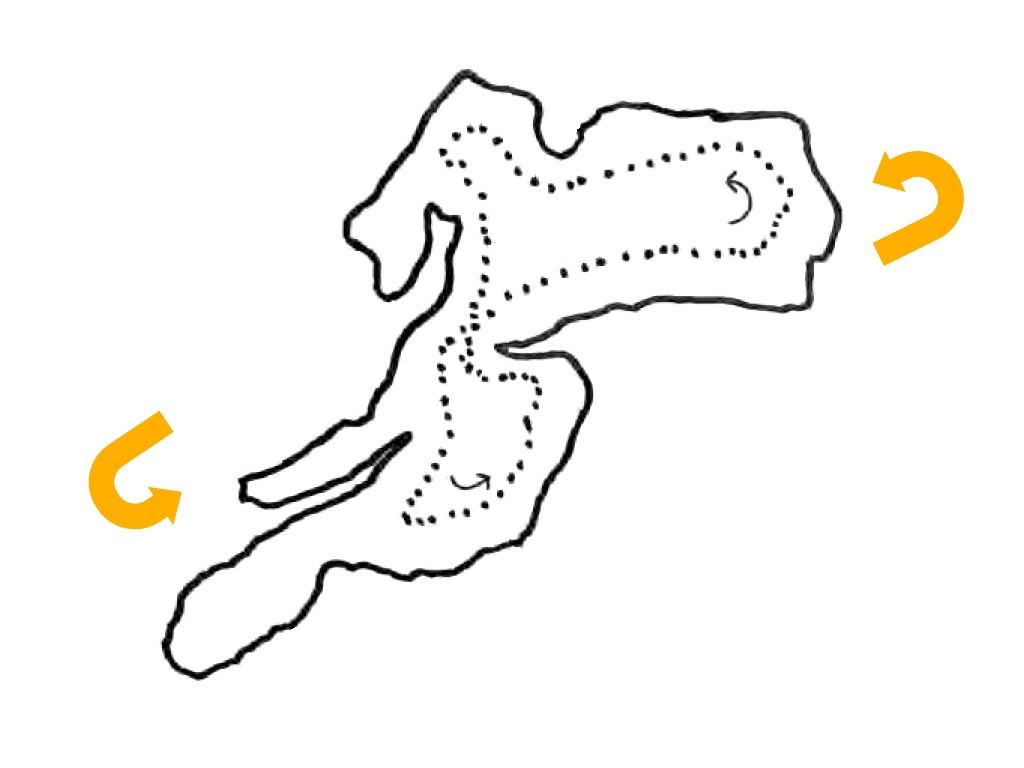
Our relatively small lake has a long-standing rule of COUNTER-CLOCKWISE travel by boats. Observing that rule greatly reduces the potential for head-on collisions. It is vitally important to comply with the COUNTER-CLOCKWISE flow of boat traffic and to make visitors and especially renters aware of the rule. 

Boating map

Take a Boating Safety Course
Contact the NH Marine Patrol Bureau at (888) 254-2125 or (603) 267-7256.

New Hampshire Marine Patrol is agrees that we need to “double the distance!” The safe passage law remains the same, restricting boaters to headway speed within 150 feet of any other boat, shore, docks, or mooring fields. Staying 300 feet from the shore and maintaining headway speed will help reduce your impact on the shoreline. 

Polution and sediment are added to the lake at an alarming rate. In rain events the ground only has the capacity to absorb so much. Because of the high water level, with the added height and additional wave power, waves are crashing onto the shoreline and affecting areas that normally would not be impacted. Storm runoff contains bacteria, pollutants, and excess nutrients that are washed into the lake. Reducing your wake and doubling your distance will help reduce your impact on Partridge Lake.

Nesting Loon

Partridge Lake Property Owners Association

info@partridgelake.org

Copyright © 2026 · PLPOA