
The “song of the loon” once heard will never be forgotten. Piercing the evening across a lake, the male loon defends his territory with yodels (unique call to every male) that can be heard up to 16 km away. While only the male yodels, both the male and female use other vocalizations. Both loons use a tremelo to announce their presence or when alarmed. The wail is the call that loons give back and forth to figure out each other’s location, and hoots are short calls given by family members to keep in touch. And yes, the term loony, short for lunatic, is referencing the cry of the loon!
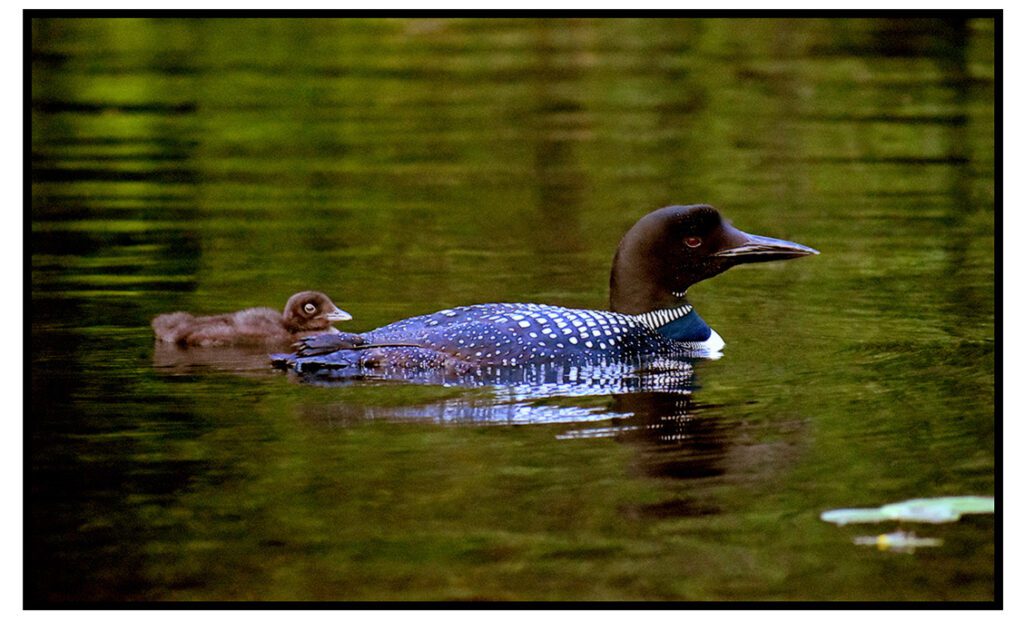
Loons are a small obsession for most lake inhabitants in New Hampshire, just like us here at Partridge Lake. We love them, we monitor them, and every year we follow the chicks like they belong to us.
But what do we really know about loons? About their history, their mating rituals and breeding habits, their diet, their life expectancy, their migration patterns, and unfortunately, their abundant threats and challenges from both nature and humans? Importantly, to whom can we turn to help us mitigate those threats and challenges and how can we help them to help us?
Most of the information for this article was provided by the Loon Preservation Committee (LPC), based in Moultonbourough, NH, and an interview with Caroline Hughes at said location. They are a non-profit organization that exists to restore and maintain a healthy population of loons throughout NH; to monitor the health and productivity of loon populations as sentinels of environmental quality; and to promote a greater understanding of loons and the natural world.
Common Loons (Gavia immer – gavia is Latin for seabird, immer is from the Icelandic himbrimi, or Great Northern Diver) have been around for a very long time. Fossils reveal that loons have been on earth about 70 MILLION years.
The loons of New England weigh between 12-16 pounds. Loons have red eyes that change to a dull color at the end of the breeding season. They can live into their late 30’s, start mating around 3 or 4 years old, and mate for life, (mostly – but more on that later).
Loons can swim fast and fly fast. Unlike most birds, loons have solid bones that make them less buoyant and better at diving. They can quickly blow air out of their lungs and flatten their feathers to expel air within their plumage, so they can dive quickly and swim fast underwater. Once under water, the loon’s heart slows down to conserve energy. They can swim underwater for up to 5 minutes. In the air, loons can fly up to 70 mph.
When on lakes, loons eat primarily fish, but will also feed upon crayfish, frogs, leeches, and snails. On their winter vacation ocean grounds, loons consume lobster (of course), fish, crabs, snails, shrimp and marine invertebrates.
In the spring, once ice is out, loons migrate back to the lakes to breed. They tend to go back to their same lakes year after year, and they tend to pair up with the same mate year after year. The perfect story exists to exemplify both the life expectancy and the breeding patterns of the loon. In Michigan’s upper peninsula at the Seney National Wildlife Refuge, 2 common loons and the world’s oldest loon couple, ABJ (36) and Fe (37), have been nesting together every spring for 25 years. They are also the most successful loon parents, with 32 hatched chicks over their 25-year love affair. However, it seems that in 2022 Fe (the cougar female) took on a new mate much to the chagrin of ABJ. However, ABJ came back to try again in 2023, but it seems he has been relegated to perpetual bachelorhood while Fe once again raised a chick with her new younger man.
Once both pair members are present on the lake, they spend a few weeks reestablishing their bond. Nest-building may occur at any point during the month of May. In NH, 50% of loon pairs begin nesting by the end of the first week of June.
Male and female loons share incubation (sitting on eggs) duties roughly equally, however the male generally takes on more in week 1 and the female in the final weeks. Loons have a typical clutch size of 2 eggs, though some may lay just 1. Eggs are laid 1-3 days apart and hatch 12-24 hours apart. The incubation period is 27.5 days on average.
Loons are presented with many nesting challenges, not to mention reproductive challenges as well. Because loons cannot walk well on land, they build their nests at water’s edge. This leaves the nest vulnerable to fluctuating potential water levels (which can flood nests or leave them stranded out of reach of incubating loons), as well as many land predators. Also, rapid growing human development (on the big NH lakes especially) has drastically reduced loon nesting habitat on many lakes, and they are pushed to using marginal nesting habitats, reducing the chance of successful nesting.
Chemical contaminants also have been shown to cause a variety of harmful health and reproductive effects in loons, including the likelihood of eggs successfully hatching. Loons are long-lived birds at the top of the aquatic food webs and are therefore at risk from contaminants that bioaccumulate (increase in animals over time) and biomagnify (increase in concentrations as they move up the food web). Mercury is a heavy metal that occurs naturally in our environment but has increased to unnaturally high levels as a result of human activity. Mercury enters our atmosphere when coal or other fossil fuels are burned to generate power, or when mercury-containing products like thermometers, batteries, and fluorescent light bulbs are incinerated. Mercury is a potent neurotoxin and can reach toxic levels in loons. Research has shown that LOONS IN NH HAVE AMONG THE HIGHEST CONCENTRATIONS OF MERCURY RECORDED IN LOONS ANYWHERE IN NORTH AMERICA.
Climate change has also impacted loon breeding success. The number of chicks hatched per nesting loon pair has declined as temperatures and rainfall have increased in NH. If further increases in temperatures and rainfall predicted by climate change models are accurate, those and other possible effects of climate change will increasingly challenge New Hampshire’s loons.
In 2023 NH had 345 pairs of loons (690) and 127 unpaired loons. 242 of those pairs nested, producing 196 chicks. 137 survived to fledging age. LPC estimates that NH could hold 450-600 pairs of loons.
It is estimated that loon parents and their 2 chicks can eat about a half ton of fish over a 15-week period. They swallow most of their prey underwater. They have sharp, rearward pointing projections on the roof of their mouths and tongue which helps them to keep a firm hold on slippery fish.
Loons remain on lakes until fall or early winter. Loons have supra-orbital (above the eye) glands that help to filter salt ions out of their blood, which allows them to live on the ocean during the non-breeding season. Loons spend the winter on the open water of the ocean. Through research since 1993, LPC and the Biodiviersity Research Institute in Falmouth, Maine, have been tracking individual loons to investigate their life history, including the relationship between their breeding and wintering grounds.
Typically, adults will leave for their wintering grounds 1-3 weeks before the chicks, when the chicks are about 12 weeks old. Chicks are often seen congregating in large groups on large lakes prior to their migration. Once the juveniles reach coastal waters on the ocean, they stay there for the next 2 years. In the 3rd year, young loons return “north”, although they may not breed for a few more years.
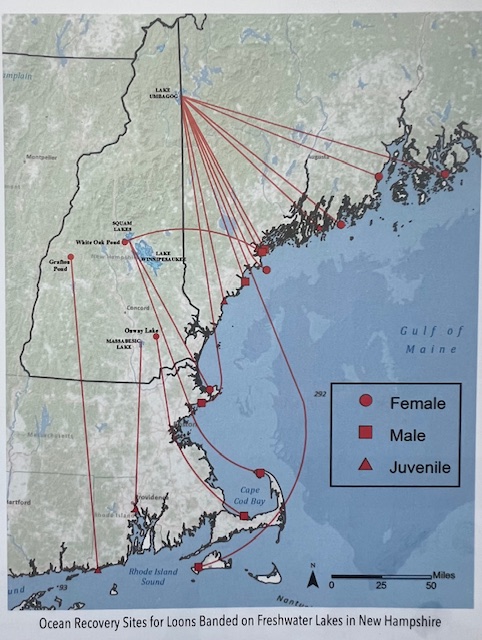
Research suggests that NH breeding loons tend to stay in the Gulf of Maine area (off the coast of Main, NH, and MA). However, a few of NH loons have been spotted along the CT and NY coasts, and 1 NH loons who nested on Squam Lake was recovered as a mortality in Cape May, NJ. The chart from LPC depicts where NH loons’ ‘winter’.
During the winter, adult loons experience a full body molt and lose all their feathers, including the feathers on their wings. They are rendered flightless until their new feathers grow in, which takes 2 weeks to a month.
Loons are large, heavy bodied birds. Relative to their body size and weight, loon wings are short and narrow. They therefore have high rates of wing loading (the amount of body weight supported by each square inch of wing). Because they have such high wing loading, loons have to work hard to fly. They may need up to 650 feet of space to take flight, but if the wind is strong, they can achieve liftoff in 100 feet or less. Basically, they need to run across the surface of the water, flapping their wings all the way. They usually take off into a headwind which means they need less distance for lift off. On windy days particularly, loon chicks as young as 8 weeks can be seen orienting themselves into the wind to attempt to take off. During this learning stage, loon chicks may stumble or crash land back on the water.
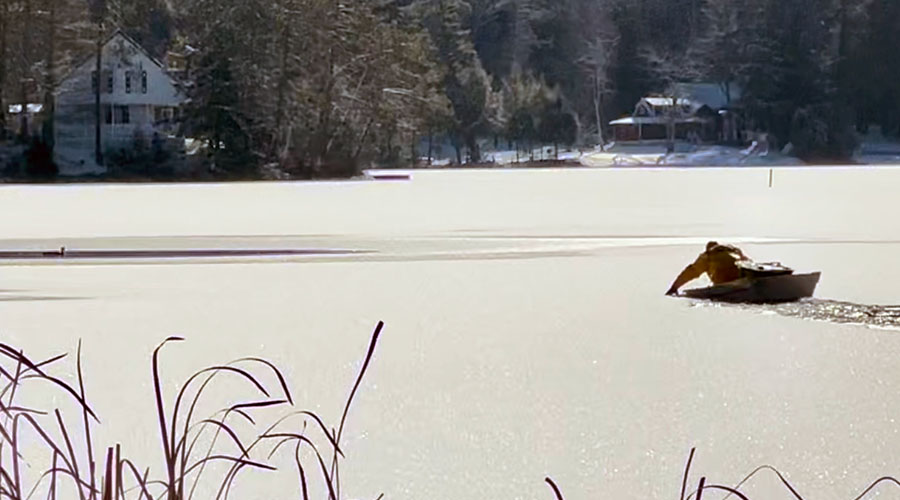
This “runway challenge” brings us to an issue near and dear to us at Partridge Lake. In December of 2022 we had a loon which was ‘iced in’, until he was left in a hole much too small for him to take off. This is when we contacted the LPC and they did what they do many times a winter, they came to rescue our loon.
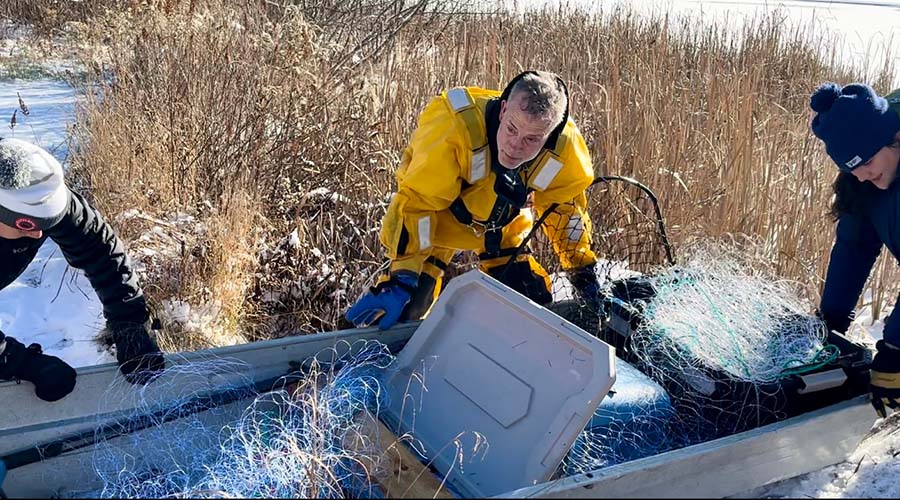
John Cooly and Caroline Hughes from the LPC came to our lake that December morning intent on saving our loon. It is a grueling task to rescue a loon. It is not a high-tech story. One must get out to the place where the loon is stuck, which is usually over a partially frozen lake, and one must also bring the gear for the rescue. John, wearing a cold weather suit and pushing, or paddling in broken ice in spots, a small boat full of gear, trudged out to the hole. After a very challenging “walk” out to the iced-in loon spot in the middle of the lake, John then set about catching the loon. It took several attempts of him throwing and regathering the net over portions of the hole hoping for the loon to reemerge and get trapped. The hole must generally be 15 feet or less in diameter for this net method to work. He had to be exhausted.
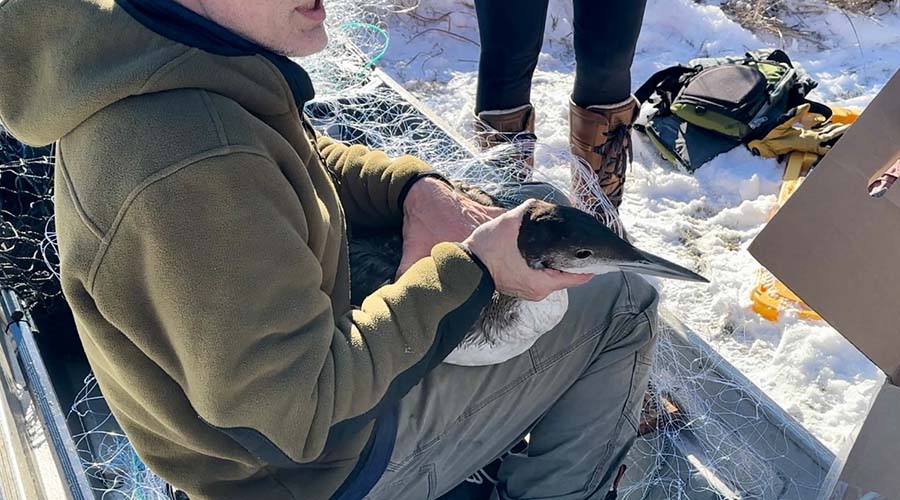
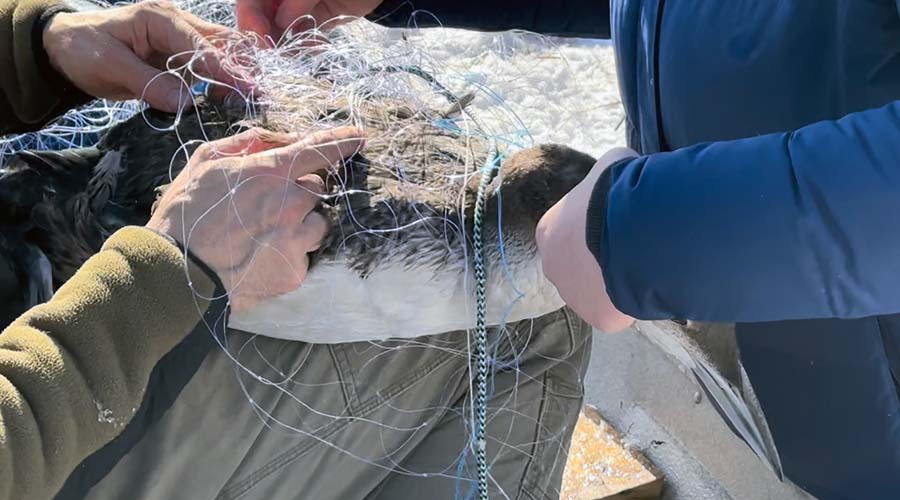
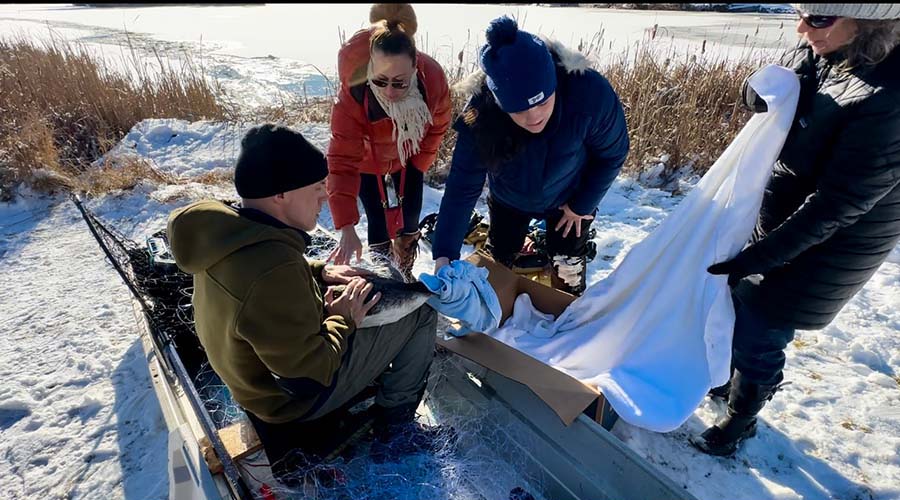
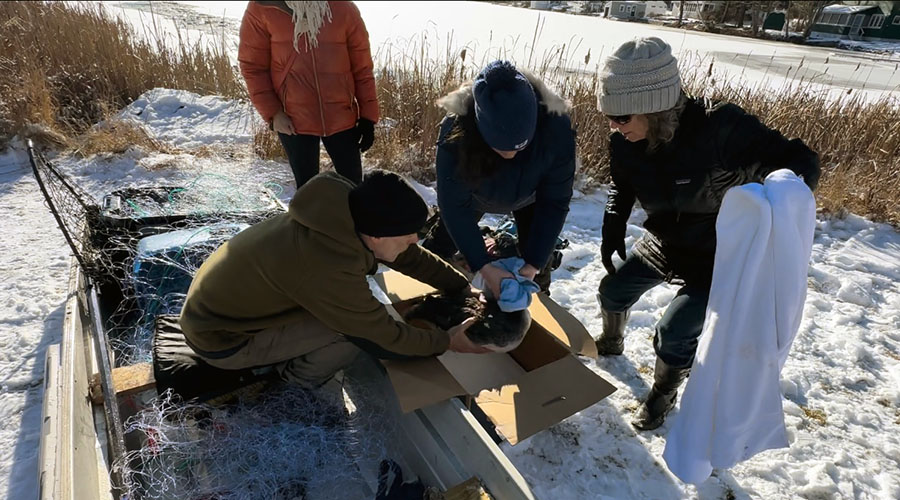
Just when all of us on the shoreline were giving up hope, he finally trapped the loon. John carefully wrapped her in the net and put her in a box to drag the boat back to shore. Once he arrived, he and Caroline started the complicated task of untangling the loon from the net. Then the loon was carefully put back in the box and they transported it back to their area to be evaluated by a vet, and to hopefully be released later on the coast. Unfortunately, our loon was not so lucky. He befell the fate of many loons. He had probably eaten a fish thrown back in the water with the hook intact and it was stuck in his system. He sadly had to be euthanized.
There are many major threats to loons, and lead tackle is the leading 1 cause of loon mortality in NH. It has been responsible for the deaths of 38.5% of the adult loons that LPC has documented from 1989-2022. Had these loons survived, NH’s loon population COULD BE 43% LARGER than it is today.
The number 1 thing that we all can do to help loons is to clean out old tackle boxes and remove any lead, and to encourage all fishermen to do so. In NH, lead sinker and lead-headed jigs weighing 1 oz. or less are illegal to use in freshwater because of what they have done to loons.
It is important we understand the causes of the challenges facing the loons and those relentless individuals and organizations that we can support to help us. The Loon Preservation Committee conducts loon monitoring, loon management (provides free of charge nest rafts and signs to lakes and other waterbodies), rescues, research, outreach and education. They are a non-profit supported solely by donation and grants. The PLPOA has proudly been one of these small donor for years. We can also help the LPC by letting them know any information about loons in distress. Their mission, as well, is to provide outreach talks and visits to lakes.
The LPC has a beautiful physical building in Moultonborough, NH and are open to the public for visits to their educational exhibits and to learn more about loons in general. It is a fantastic place to visit with inquisitive children. Visit loon.org for more information.
Our lake can’t thank the Loon Preservation Committee enough for all they do for us, including rescues and providing us with a loon nest raft, which they have generously offered to replace this year as our raft has seen better days at this point, and we at Partridge Lake certainly want to do everything we can to help our loons thrive.
The following references were also used in writing this article:
- Common Loon – Eastside Audubon Society, by Andy McCormick, June 10, 2018
- National Park Service, Fairbanks, Alaska, updated April 30, 2021
- Wilderness North, June 30, 2022, Lisa M. Genier, Adirondack Council Program Analyst
Photgraphy by Tom Allen.
In the photos: John Cooley, Senior Biologist at LPC, and Caroline Hughes, Biologist at LPC, & various lake people.
